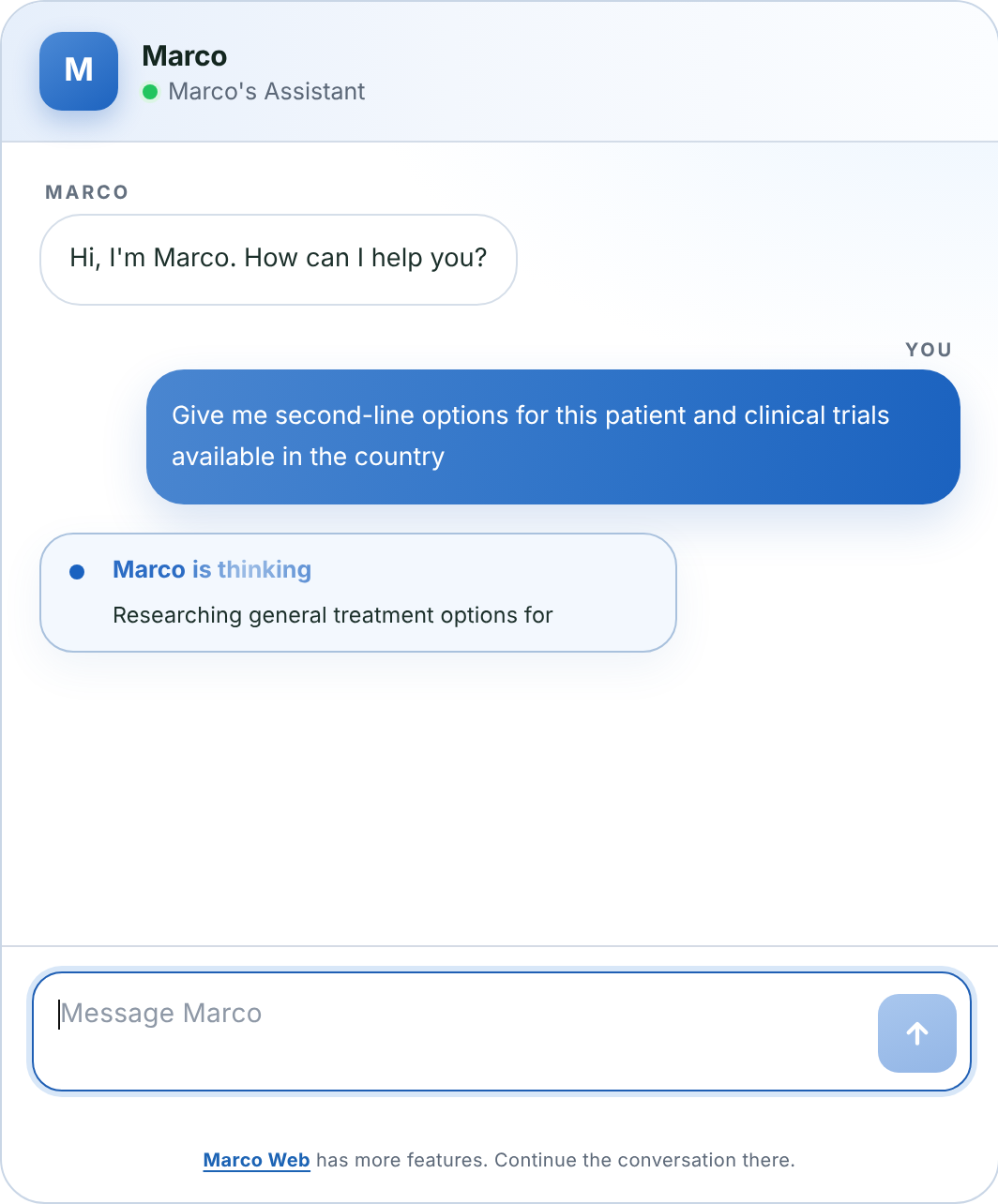
Marco lives inside the patient chart. When the oncologist opens it, the case context is already loaded and they can ask in plain language, without leaving the workflow or typing a single field.
Why evidence doesn't reach the point of care
Approvals, actionable biomarkers and eligibility criteria change continuously. The institutional protocol falls behind without anyone noticing.
Opening another tab competes with the exam room. The lookup ends up happening only in the cases that already felt uncertain.
Teams already consult general-purpose assistants with patient data. No control over sources, no traceability. The institution didn't choose that risk, but it has it.
Marco in the patient chart
Marco receives the patient's clinical context. Nothing to copy, paste or summarize.
About the chart or about the evidence. “What are the second-line options?” is a valid question, because Marco already knows the case.
Guidelines, clinical trials, primary literature and regulatory registries, cross-checked against the institutional protocol when available.
With its context, its answer and its references. Auditable, without the physician documenting anything extra.
Marco doesn't add one more tool to the physician's desktop. It occupies the only place where looking something up costs nothing: the chart that is already open.
One widget, three benefits
The oncologist
Medical leadership
The institution
Against what's already in the service
| Traditional clinical reference | General-purpose AI assistant | Marco in the patient chart | |
|---|---|---|---|
| Knows the patient's case | No | Only if the physician types it | Yes, loaded automatically |
| Cited, verifiable source | Yes | Variable | Yes, on every answer |
| Data under institutional control | Not applicable | No | Yes, protected session |
| Traceable log for audit | No | No | Yes |
| Inside the workflow | No | No | Yes, inside the chart |
How it starts
A session using anonymized cases from your own service. The clinical team sees the product against their reality, not a generic example.
Integration with your EHR vendor. No development on the institution's side and no training for the medical staff.
Scope, baseline and metrics agreed with medical leadership before starting, and a review at close against those same indicators.
Get started
A session with anonymized cases from your institution, with your clinical team present.