Patterns and trends in global prostate cancer incidence.
A recent study analyzed global prostate cancer incidence and mortality trends using data from GLOBOCAN and the World Health Organization. The highest incidence rates were observed in Australia/New Zealand, North America, Northern Europe, and Latin America/the Caribbean, while mortality was highest in sub-Saharan Africa and Latin America/the Caribbean. Although mortality has declined in many countries due to early detection with PSA and improved treatments, some countries—particularly in Africa, Asia, and Latin America—show increases associated with limited access to quality diagnosis and treatment.
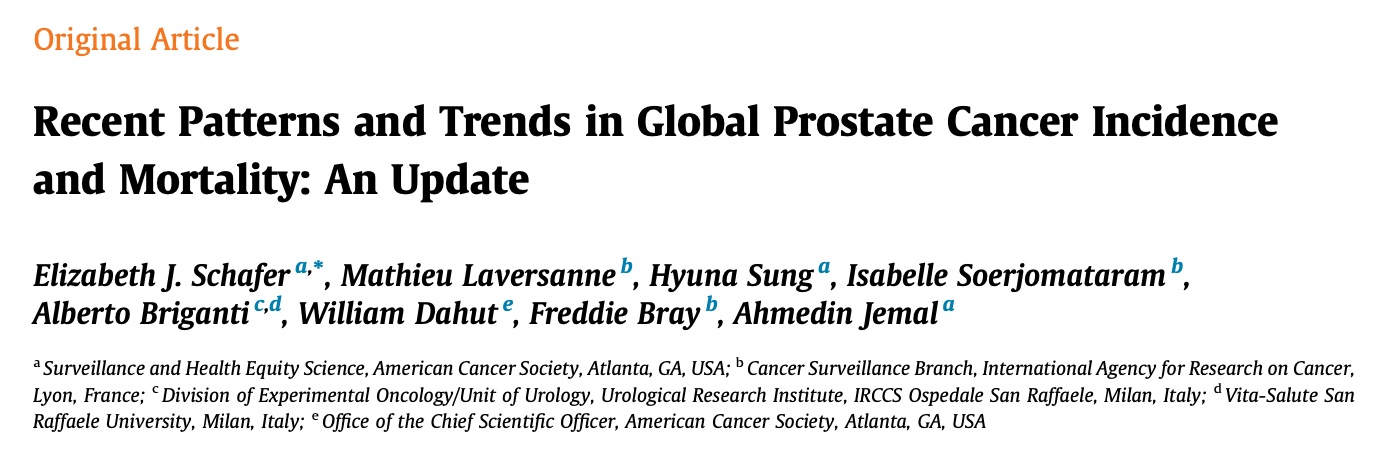
This study, recently published in European Urology, aimed to examine global patterns and trends in prostate cancer (PC) incidence and mortality using high-quality, up-to-date population data.
Age-standardized PC incidence and mortality rates were analyzed by country and region based on GLOBOCAN 2022 estimates, along with temporal trends in incidence (50 countries/territories) and mortality (59 countries/territories) using data from the Cancer Incidence in Five Continents series and the World Health Organization mortality database.
The highest incidence rates were found in Australia/New Zealand, North America, Northern Europe, and Latin America/the Caribbean. The highest mortality rates were recorded in sub-Saharan Africa and Latin America/the Caribbean. During the last 5 years of the analysis, incidence rates increased in 11 of the 50 countries included in the study, and mortality rates increased in nine of 59 countries, most of which are located in Africa, Asia, Latin America/the Caribbean, and Central and Eastern Europe. Mortality rates decreased in 38 countries, mostly located in Europe, Oceania, and Latin America/the Caribbean.
In Latin America and the Caribbean, the incidence rate per 100,000 men varied more than fourfold among the seven countries included in the study, ranging from 38.2 in Argentina to 168.0 in Martinique. Mortality rates per 100,000 men ranged from 9.3 in Puerto Rico to 25.8 in Cuba. Four of the 10 countries with the highest mortality were located in Latin America (Cuba, Venezuela, Uruguay, and Paraguay). Incidence rates continued to decline by approximately 1.0% per year in Argentina, Colombia, and Puerto Rico, and remained stable in the other four countries.
Mortality rates decreased by approximately 1.0% to 4.0% per year in eight of the 14 Latin American and Caribbean countries examined, increased by approximately 1.0% to 8.0% per year in Venezuela, Paraguay, Cuba, and Guatemala, and remained stable in Mexico and Nicaragua.
The downward trend in mortality rates in many countries across Europe, North America, Oceania, and Latin America/the Caribbean is likely the result of improvements in early detection of advanced-stage cancer and better treatments. Previous studies estimated that PSA screening accounted for 45% to 70% of the decline in the prostate cancer mortality rate in the U.S., and improvements in treatment accounted for 22% to 33% of the decline. A 2021 study in Lithuania, where a national screening program was implemented
for prostate cancer based on PSA in 2006, found that among individuals diagnosed with prostate cancer, the standardized prostate cancer-specific mortality risk ratio was higher for those who did not participate in the national screening program (20.95, 95% CI 20.00–21.94) than for those who did (8.99, 95% CI 8.63–9.37).
On the other hand, the increase in mortality in a subgroup of analyzed countries may reflect an increase in incidence, as well as limited availability of early detection services and high-quality treatment. For example, according to the WHO, there are fewer than three radiotherapy machines per million inhabitants in South Africa and Cuba, compared to more than 10 machines per million inhabitants in the U.S., Germany, and Sweden. Only 28% of prostate cancer patients survive 5 years in South Africa, compared to more than 90% in high-income countries such as the U.S. (97.0%), France (93.1%), and Australia (94.5%), where early detection and treatment services are more accessible.
Citation
Recent Patterns and Trends in Global Prostate Cancer Incidence and Mortality: An Update
Schafer, Elizabeth J. et al. European Urology, Volume 0, Issue 0

Dr. Federico Losco
Federico is a prominent Argentinian Oncologist, Director of the Latin America Oncology Group (LACOG) and Chief Medical Officer of Marco